


- CMOS-Compatible Quantum Processor
Q-Memory Photonic Quantum Processor
We submitted 28 inventions across 6 families to the UK Patent Office (IPO)
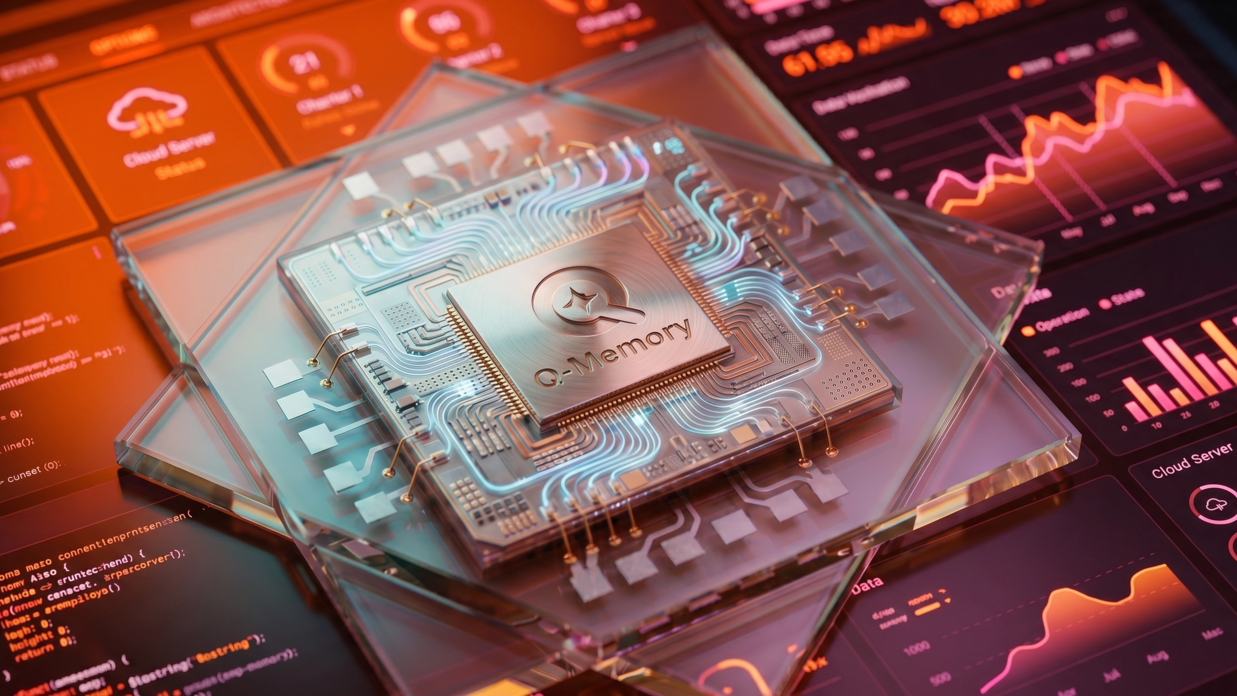
A room-temperature quantum processor, simulated down to the photon
- This is the actual 4-mode photonic mesh queued for UK silicon-nitride foundry — every waveguide, splitter, and heater below was extracted from the real GDS layout and run through a circuit simulator, not sketched for a slide.


Quantum computing, AI acceleration, and secure communications all integrated into a single chip
One Chip. Three Breakthroughs
Our photonic chip runs at room temperature — only the photon detector needs cooling, in a unit the size of a server rack, not a room. A reconfigurable mesh of light channels performs both quantum computation and AI matrix multiplication, reprogrammed entirely in software with no hardware change.
Room-Temperature Quantum Computing
Programmable photonic processor for NISQ algorithms and quantum reservoir computing, with no dilution refrigerator.
AI Acceleration at the Speed of Light
An optical mesh performs matrix multiplication using photons instead of electrons, targeting ~100× lower energy per operation than a GPU.
Standard CMOS foundry
On-chip entangled photon generation for quantum key distribution — encryption secured by the laws of physics, not computational hardness.
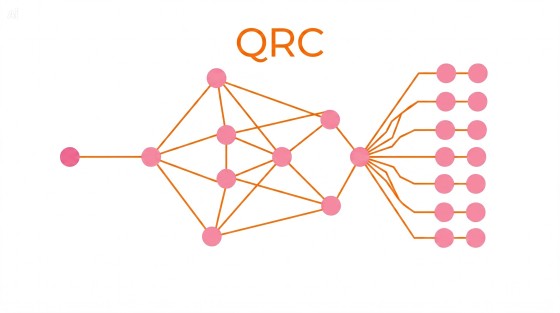
Quantum ML with no fault tolerance
This layer locks every mirror at zero static power, saving an additional 490 W per 256-mirror chip.AI model weights persist across power cycles with no re-programming. No other photonic AI chip has demonstrated yet
Use Cases & Applications
Quantum ML — Predictions from Noise
Predictive Analytics
Quantum Data Centre — Rack-Scale Photonic Computing

- Star topology — core fusion chip (256-mode)
- 655 TOPS at ~10 fJ/MAC — GPU-comparable
- 40 kW replaces ~2 MW for equivalent AI
- ~€480K/year saved per rack vs an equivalent GPU cluster
The Quantum Internet
Unbreakable Communications
Q-Memory vs Others
The advantages of q-memory architecture over other classical quantum solutions.
Dual-mode platform
quantum compute + AI matrix multiply on the same chip. Q-Memory can generate commercial AI revenue in 2027
PCM non-volatile phase memory
locks mirror positions with zero continuous power, saving ~490 W in a 256-mode design
Quantum-Kernel ML on hardware
quantum kernel methods run on the 64-mode SiN + SNSPD chip with no fault tolerance, no error correction and no added hardware, outperforming classical kernels on structured datasets